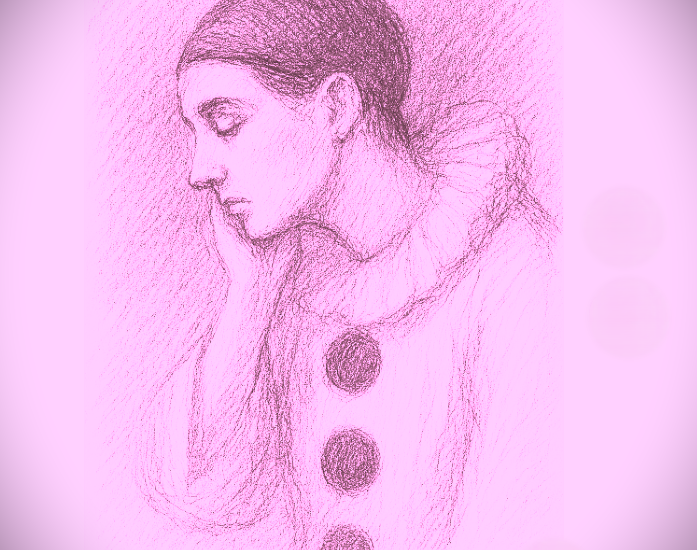
What does the word ‘mime’ mean to you? For many people, it suggests silence: a performer with a white face, isolated in a pool of light, communicating through gesture alone. But Irene Mawer (1893-1962) developed a very different strand of the silent art – one that was rigorous, literary, and fully integrated into theatre training.
For Miss Mawer, mime was never an isolated art form, nor a novelty act or an optional extra to dance. It was part of a complete theatre education, required of actors and dancers alike. In her book The Dance of Words (1925), she makes clear that words are not meant to sit passively on the page, nor are they only for speaking. Words, in her view, could be danced. She explored the partnership between movement and speech with precision.
One of her poems, Fire, is a Nature Rhythm intended for group performance. The fire begins “in a group of figures” from which smoke spirits and coloured flames gradually emerge. Movement is shaped directly by language and the performers respond to rhythm and the description embedded in the text. Mime is not a display of skill or a literal imitation of fire. Instead, performers embody its stages: an initial stillness, followed by ignition, growth, struggle and decline. The work is theatrical, structured and emotionally charged.
Ensemble work was a large part of her teaching. Individual movement could grow out of a collective stillness as students learned to respond physically to one another. At the Ginner-Mawer School, mime sat alongside voice control, diaphragmatic breathing, choral speaking, acting, and theatre history. Mime underpinned everything and students were expected to bring mime into any performance.
There was a particular focus on the natural world, expressed in mime through Nature Rhythms. Students might express fire, wind, water, or indeed, anything from nature. Hands were important tools of expression, but rarely worked alone; movement travelled through the whole body – spine, torso, limbs, expanding, contracting and flexing as the rhythm demanded. Rhythm was noticed in spoken word as well as in music.
Miss Mawer’s legacy is fragile: the Institute of Mime dissolved after the Second World War, and the Ginner-Mawer School closed in 1954. Only one film recording of her work survives, and it is of poor quality. What does remain, though, are living memories, textbooks and exercises handed from teacher to pupil.
Miss Mawer did not build a brand, and her work did not travel in any major way, yet for some thirty or so years, she influenced schools across Britain. She published what has been described as a seminal text, The Art of Mime (1932). So, to call her work a lost strand is not to suggest failure. Rather, it recognises how easily an art form can fade. She devised a system for training the whole performer, and in her vision, mime and voice were often partners, not rivals.